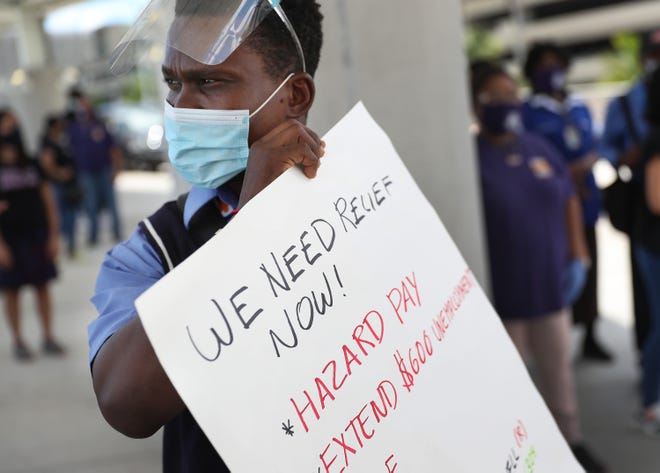
As thousands and thousands of individuals have misplaced jobs within the coronavirus-induced recession, the additional $600 in help from the federal authorities started chipping away at a long-standing hole between the unemployment advantages acquired by Black People and white People.
However with Congress at a months-long deadlock over a brand new aid package deal that may renew the $600, which expired in late July, that hole is widening once more simply as family monetary misery, significantly for Black employees, is growing.
The $600 weekly complement to unemployment advantages, included within the CARES Act, handed by Congress in March, together with expanded eligibility for the help, raised incomes for low-wage employees. State advantages alone cowl solely roughly 40% of employees’ prior wages usually, says Eliza Forsythe, a labor economist and assistant professor on the College of Illinois at Urbana-Champaign.
The $600 weekly bonus helped slim historic earnings inequality between Black employees and white employees that worsened early within the well being disaster when layoffs largely affected individuals in low-paying jobs disproportionately held by Blacks and Latinos.
Taking a toll:Black girls and Latinas battle to purchase meals, construct financial savings amid COVID-19, examine says
Protests:A ‘Strike for Black Lives’ will carry collectively employees calling for finish to systemic racism
Hole in unemployment advantages for Blacks and whites grows
Though a lot of the disparity in job losses between demographic teams equivalent to Asians and whites narrowed as of July, the hole between Black and white employees doubled in dimension, in keeping with Forsythe.
“For Black employees, it’s gotten worse because the pandemic has dragged on,” Forsythe say. “They’ve been much less prone to bounce again and discover jobs than different teams.”
Structural racism within the U.S. has performed a job in entry to advantages up to now, in keeping with Michele Evermore, senior researcher and coverage analyst for the Nationwide Employment Regulation Venture. However she stated that accessing jobless help disproportionally impacts individuals of coloration.
“The CARES Act stuffed in a whole lot of the inequalities,” says Evermore, including, “however now we’re undoubtedly shifting again to a spot the place the inequalities are popping out once more.”
In actual fact, Black People usually tend to be unemployed however are the least prone to obtain jobless help, specialists say. One cause is that some Black employees who’re eligible for advantages don’t apply, in keeping with Alix Gould-Werth, director of household financial safety coverage on the Washington Heart for Equitable Progress.
In 2012, Gould-Werth’s analysis confirmed that in some situations Blacks employees have been discouraged from making use of as a result of they thought that they have been ineligible, they didn’t know the place or apply, or they didn’t know advantages existed.
These employees might face discrimination when making use of for advantages, have issue finishing the applying course of or face issue satisfying eligibility standards.
Gould-Werth revealed separate analysis in 2016 that famous how employers and office climates can form each white and Black employees’ entry to advantages. Some Black respondents reported that they thought they did not work sufficient or earn sufficient. Due to unequal therapy, there could possibly be disparities in Black employees’ advantages, although Gould-Werth’s 2016 examine didn’t study this query.
Black employees much less prone to get help
President Donald Trump asserted at Thursday’s last presidential debate that his administration recorded the “finest Black unemployment numbers within the historical past of our nation.”
To make certain, the unemployment charge for Black employees dropped to a file low of 5.4% in August 2019. The worst world pandemic in a century, nonetheless, has undone years of good points.
From April to June, solely 13% of Black employees who have been unemployed acquired unemployment checks, in contrast with 24% of white employees, 22% of Hispanic employees and 18% of employees from different races, in keeping with an evaluation by Nyanya Browne and William Spriggs of Howard College, who used COVID Influence Survey knowledge from the Nationwide Opinion Analysis Heart on the College of Chicago.
A cause for the low charge amongst Blacks is that they are extra prone to stay in Southern states that have been among the many slowest to roll out the improved advantages, Spriggs says.
After persevering with to falter as white employees recovered quicker, Black unemployment has remained elevated throughout the pandemic. In Might, Black unemployment climbed to 16.8%, the very best in additional than a decade because the pandemic worn out greater than 22 million jobs.
Jobless charges for whites and Blacks have fallen in current months as extra components of the economic system reopen, however the charge for whites has come down a lot quicker. In September, the white jobless charge fell to 7%, in comparison with 12.1% for Blacks; 10.3% for Latinos and eight.9% for Asians.
“It’s a double whammy for Blacks and Latino employees,” Forsythe says. “Each teams usually tend to have been affected by the virus and now have their financial fortunes upended. They’re actually bearing the brunt of either side to this disaster.”
The hole in unemployment between Blacks and whites narrowed in September for the primary time in 5 months after hitting the widest stage in practically six years over the summer time. But it surely got here as practically 200,000 African People dropped out of the labor drive final month.
In September, unemployment for Black women and men stood at 12.6% and 11.1%, in keeping with the Labor Division. That compares with 6.5% for white males and 6.9% for white girls.
Racial disparity in unemployment help
Blacks’ better propensity for dwelling within the South is an enormous cause they path whites in receiving unemployment advantages, in keeping with Kathryn Edwards, an affiliate economist at RAND Company, a nonprofit coverage suppose tank.
Six states have a near-zero share of the nation’s Black workforce: Maine, South Dakota, Idaho, Vermont, Wyoming and Montana, in keeping with RAND. One other dozen states have fewer than 0.5 % every. And 1 in Four Black employees lives in simply three states: Texas (8.5%), Florida (8.1%) and Georgia (8%).
One other drawback, Edwards argues, is that states within the South with extra Black employees have much less beneficiant unemployment advantages. Nationally, Black employees are much less financially supported on unemployment than white employees just by advantage of the place they stay, she says.
Unemployed Black employees – and unemployed Black girls employees – even have been a lot much less prone to obtain jobless advantages because of “racist biases” towards low-income employees of coloration, in keeping with the Washington Heart for Equitable Progress.
In consequence, nationally, the typical most weekly profit for black employees is $40 in need of the quantity acquired by white employees.
State variation in advantages are large
In Massachusetts, probably the most beneficiant state, advantages are capped at $823. However in Mississippi, the least beneficiant state, the cap is $235. About 7.3% of the labor drive is Black in Massachusetts, in contrast with 36.2% of the labor drive in Mississippi, in keeping with the Census Bureau.
Relying on the state, the withdrawal of the extra $600 results in a median minimize in advantages of 52% to 72%, knowledge from the Washington Heart for Equitable Progress reveals. Arizona, Louisiana and Mississippi are amongst states that may see the most important reductions in advantages, with median declines of 71%, 71%, and 72%, respectively.
“Primarily based on the place Black employees stay, they’re going to get much less in unemployment insurance coverage as a result of they aren’t evenly distributed throughout the U.S.,” Edwards says.
“That is the hazard of getting insurance policies that change by state. The variations might imply that you find yourself with large disparities in unemployment advantages since some states are extra beneficiant than others.”

Unemployment’s historical past with Black employees
Students have debated whether or not the unemployment insurance coverage system was constructed to be racist, or whether or not it is not intentional that Black employees profit much less.
Edwards and Evermore argue that there was racist intent behind the exclusions primarily based on the design of this system and who it deliberately, or by the way, leaves out.
The explanation unemployment is run by states – not like Social Safety, which is federally operated – dates again to the New Deal laws within the 1930s, specialists say.
In 1935, Congress handed the Social Safety Act, which created unemployment insurance coverage. The federal authorities oversaw Social Safety, whereas states ran the unemployment applications. Each have been social-insurance applications: Employees paid into belief funds by way of a payroll tax, making them eligible for advantages, in keeping with Edwards.
Some lawmakers have been involved that the Social Safety Act would have been caught down by the Supreme Court docket if the unemployment insurance coverage system have been federal, so states have been left to run this system. That gave states leverage to resolve who was eligible.
State-level was perceived to be a safer wager after the Supreme Court docket had struck down key provisions in prior New Deal laws for being an unconstitutional use of the interstate commerce clause.
Northern Democrats needed to make a discount with Southern Democrats to get sufficient votes in Congress to cross the New Deal laws. Southern Democrats feared that an economically empowered Black employee posed a political menace to segregationist social constructions, Edwards says. So Northern Democrats needed to give Southern Democrats the means to exclude Black individuals from receiving advantages, she stated.
Extra exactly, the laws barred agricultural and home employees from the unemployment program, which had a disproportionate impression on Black employees, significantly Southern sharecroppers, in keeping with Evermore.
About 65% of Black employees on the time fell exterior the Social Safety Act, in contrast with 27% of white employees, in keeping with the Social Safety Administration.

Racial disparities stay
In the present day’s inherited unemployment system has racial implications that persist since Black employees usually tend to stay in states with extra stringent profit techniques, specialists warn. Evermore, citing the City Institute, an financial suppose tank, stated that throughout the Nice Recession, Black employees have been on common 13% much less possible than white employees to obtain advantages, and Latino employees have been 4% much less possible.
In 2010, the Social Safety Administration argued that excluding the vast majority of Black employees from unemployment wasn’t the results of “prevailing racial biases.” As an alternative, the company stated leaving out agricultural and home employees from this system early on was because of issues about employees who would pose tax-collection issues for the Treasury.
Eighty-five years after the Social Safety Act handed, disparities stay by way of the share of unemployed Black employees who get advantages, the size of time it takes to get them and the quantity, Edwards says.
“The urgency of the pandemic is getting help to employees to maintain them solvent and stopping the scars of the recession from hitting too deeply,” Edwards says. “However the perennial query about unemployment insurance coverage now could be whether or not that is serving to Black employees as a lot because it’s serving to white employees. Sadly, the proof factors to no.”
Stimulus talks falter as aid dries up
Spriggs of Howard College argues that Congress wants to spice up advantages for unemployment employees because the pandemic drags on and completely develop who is roofed by unemployment.
The CARES Act expanded who was lined by unemployment with Pandemic Unemployment Help, which allowed individuals who beforehand didn’t qualify below conventional unemployment to hunt help, together with momentary and part-time employees. That opened the door for extra minorities in lower-paying jobs to qualify, Spriggs says.
However many out-of-work People will exhaust their common state unemployment help by Christmas.
“Historical past hasn’t modified. We now have to rewrite the unemployment insurance coverage legal guidelines,” Spriggs says. “Regardless of current efforts by Congress, Blacks are nonetheless disproportionately in jobs that have been initially written out of the Social Safety Act. We have not basically modified who has entry to unemployment insurance coverage.”
With Congress deadlocked on a brand new aid package deal, Trump in August issued an government motion that allowed states to faucet $44 billion from catastrophe aid funds, which offered $300 every week in enhanced help for unemployment employees. However these funds have dried up since states have been approved to pay as much as simply six weeks of advantages from the week ended Aug. 1.
Black employees usually have much less of a monetary cushion throughout recessions andexperience longer bouts of unemployment, Spriggs added.
“These racial disparities have actual penalties. Many individuals are going to be evicted and have a really exhausting time placing their lives again collectively,” Spriggs says. “Regardless of individuals’s finest efforts, they get hit once more in one other recession and these disparities will wipe out their financial savings. You may’t change the racial wealth hole till we face what we obtained incorrect.”
The post Gap widens between unemployment aid for Blacks, whites appeared first on Correct Success.
source https://correctsuccess.com/finance/gap-widens-between-unemployment-aid-for-blacks-whites/


No comments:
Post a Comment